How the certified TEHNi aluminium entrance door shields your home.
What Is the Significance of a Certified Burglar-Resistant Door?
EN 1627 is a European standard that defines the requirements and tests for certifying a building component (door, window, frame, railing, etc.) as burglar-resistant.
The standard does not concern only the material (e.g. aluminium or steel), but the entire construction: frame, sash/leaf, hinges, locks, glass surfaces if present, and generally all points that a burglar will attempt to breach.
The test for certifying a product according to EN 1627 includes a combination of three sub-standards:
- EN 1628 — Resistance test under static load (static pressure)
- EN 1629 — Resistance test under dynamic load (e.g. impact, blow)
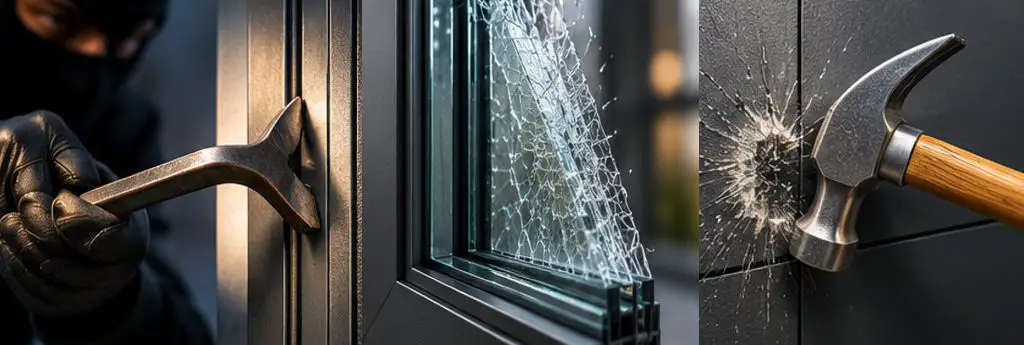
- EN 1630 — Test involving an attempt at manual burglary using tools, pressure and attempted forced entry
In other words, EN 1627 certification means that TEHNi doors have been tested under realistic attack conditions.
What “Burglar Resistance” Means (Burglar Resistance / Burglar Retardant)
The term burglar resistance (or, more accurately, burglary retardance / burglary resistance / burglar retardant) refers to the ability of the construction to resist an attempted breach — that is, to prevent or delay entry for a significant period of time.
The rationale is that the more time required to breach the door, the greater the chances that the burglary will fail (e.g. due to noise, reaction, the burglar’s need to escape, etc.).
In order for a product to be considered truly burglar-resistant, as TEHNi doors are, it must:
- Be certified as a complete system (not only as a material)
- Have passed the static load, dynamic load and burglary-attempt tests
- Have a glass surface (if present) with suitable resistance. Certification according to EN 356 is usually required for break-resistant glazing when the frame includes glass.
Resistance Categories: RC Levels (Resistance Classes)
The standard classifies resistance into six (6) main categories — from RC1 (lowest) to RC6 (highest).
| Category | What It Means / What It Resists | Typical Use / Recommended Applications |
|---|---|---|
| RC1 (or RC1N) | Human force only (kick, push, shoulder impact, attempt to force entry). No tools or only minimal tools. Test duration: approximately 1 minute. | Low-risk areas, upper-floor windows, basic protection. |
| RC2 | Simple tools such as screwdrivers, pliers, wedges and small levers. Test duration: approximately 3 minutes. | Homes and apartments where basic protection is required. |
| RC3 | Stronger tools such as crowbars, larger screwdrivers, levers and hand drills. Test duration: approximately 5 minutes. | Homes with increased risk, commercial premises and small shops. |
| RC4 | Heavier tools including hammers, chisels, saws and electric drills. Test duration: approximately 10 minutes. | Professional premises, warehouses, shops with valuable goods and buildings with increased security requirements. |
| RC5 | Powerful electric tools such as circular saws, drills, jigsaws and cutting equipment. Test duration: approximately 15 minutes. | Industrial buildings, warehouses with valuable goods and businesses requiring very high security. |
| RC6 | Maximum resistance against powerful electric or hydraulic tools, heavy cutting tools and full burglary equipment. Test duration: approximately 20 minutes. | Banks, government and military buildings, museums, high-security facilities and data centres. |
All TEHNi doors have RC certification from official European Institutes, reaching up to RC3, as well as the corresponding certified safety glazing, providing guaranteed security for your home.
Aluminium Doors & Frames – Application of EN 1627
- Aluminium frames and doors can be certified according to EN 1627 and classified under one of the RC categories, just like frames made of other materials.
- Certification concerns the entire system — frame, leaf, lock, hinges and, where applicable, the glazing — not simply the aluminium or an individual component.
- When there is a glass surface, suitable safety glazing is required for reliable protection, especially for higher RC categories.
- In many cases, manufacturers and traders describe products as burglar-resistant without official certification. For this reason, it is important to request the official test report from a recognised laboratory.
How to Choose the Right RC Category
The appropriate category depends on:
- The type of building (home, shop, warehouse, office or high-risk facility)
- The location and burglary risk
- The balance between security and cost
- Whether the door includes glazing requiring certified protection
Typical Recommendations
- RC2 or RC3 — Recommended for ordinary homes (certifications held by TEHNi doors)
- RC3 or RC4 — Suitable for higher-risk areas, commercial premises and warehouses
- RC5 or RC6 — Recommended for banks, safes, industrial facilities and buildings with very high security requirements
What to Pay Attention To – What “RC” Does Not Mean Without Proof
- The material alone (aluminium) is not enough. The frame, locks, hinges, glazing and the complete construction must be tested as one certified system.
- If glazing is included, it should also be certified (e.g. EN 356), especially for higher RC categories.
- Marketing claims such as “burglar-resistant” or “security lock” are not proof of certified performance.
- Correct installation is essential. Even a certified door loses much of its effectiveness if installed incorrectly.
Conclusion – Why Certification Matters
Certification according to EN 1627 provides a measurable and objective assessment of a door’s ability to resist burglary.
For aluminium entrance doors and frames, certification of the complete system (frame, leaf, lock and glazing) ensures that the product is not simply marketed as secure, but has been independently tested under realistic attack conditions.
The appropriate RC category depends on the intended use, location and security requirements. For residential applications, RC2–RC3 is generally sufficient, while high-security facilities may require RC5–RC6.
Finally, always request the official test report from a recognised laboratory to verify that genuine certification has been carried out.
Frequently Asked Questions (FAQ)
1. What exactly does RC mean?
RC stands for Resistance Class. It indicates how resistant a door or frame is to an attempted burglary, depending on the tools used and the time required to breach it.
2. Does the EN 1627 standard also apply to aluminium?
Yes. EN 1627 is not limited to a specific material. Certification applies to the complete system, including the frame, leaf, locks, hinges and glazing.
3. If a door is described as “burglar-resistant”, does that mean it is RC certified?
Not necessarily. The only reliable proof is certification by a recognised laboratory together with an official test report according to EN 1627 (and EN 1628, EN 1629 and EN 1630).
4. What happens when the door has glass?
The glazing must provide suitable resistance, usually through certification according to EN 356, particularly for higher RC categories.
5. Which RC category is recommended for a home?
RC2 or RC3 is generally recommended. RC2 provides protection against simple tools, while RC3 offers increased resistance against stronger tools and prying attempts.
6. For which buildings is RC5 or RC6 required?
These categories are intended for facilities with very high security requirements, such as banks, museums, government or military buildings, industrial facilities and secure storage areas.
7. Do TEHNi doors have burglar-resistance certification?
Yes. All TEHNi doors have RC certification from official European Institutes, reaching up to RC3, together with the corresponding certified safety glazing, providing guaranteed security for your home.