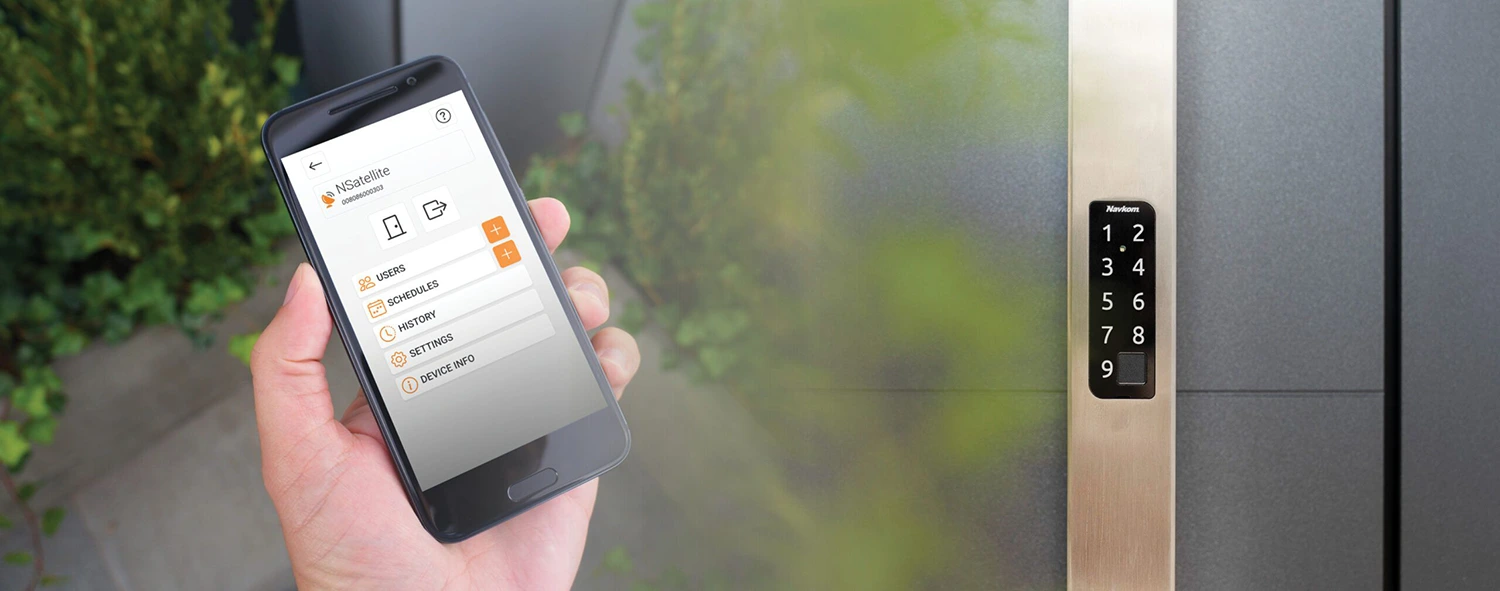
Premium aluminium entrance doors are no longer evaluated only by their design, thermal insulation and mechanical security. Modern fingerprint access systems add a new level of convenience and controlled access, allowing the user to open the door without a key, card or code.
How does fingerprint access work?
The sensor records specific characteristics of the fingerprint and compares them with the stored biometric templates of authorised users. When a registered fingerprint is recognised, the system sends a command to the motorised lock to unlock the door.
In advanced solutions, the reader can be discreetly integrated into the door leaf or the door handle, preserving clean architectural lines. TEHNi offers the option of integrating the BIO Entry fingerprint scanner into selected GripLine handles, such as Vision and Soft Touch.
What are the main advantages?
The most important advantage is that the finger functions as a personal “key” that cannot be forgotten or lost. Depending on the system, the owner may also add or delete users, define time-limited access and receive notifications when the door opens. Certain solutions, such as those used in TEHNi doors, also offer remote opening and connection with smart home systems.
At the same time, the full integration of the sensor into the handle creates a premium aesthetic result, without additional external devices that disrupt the design of the entrance.
Is a fingerprint system secure?
Security does not depend only on the sensor. A complete system must combine:
- motorised multi-point lock,
- encrypted communication and secure data storage,
- protected control unit inside the door,
- protection against fake fingerprints or other presentation attacks,
- an alternative entry method, such as a mechanical key or keypad.
The ISO/IEC 30107 series of standards concerns the evaluation of presentation attack detection mechanisms in biometric systems, while IEC 60839-11-1 and IEC 60839-11-2 cover requirements for the operation, installation and maintenance of electronic access control systems.
What should you check before choosing?
Ask for information about protection against moisture and outdoor conditions, the number of users, operation in the event of a power failure, the software update policy and the method used for storing biometric data.
Wet, very dry or injured fingers may occasionally affect recognition. For this reason, it is recommended to register more than one finger and to maintain an alternative access method.
Biometric data used for the unique identification of a person are considered a special category of personal data under the GDPR. Therefore, especially in professional or shared buildings, clear information is required on how they are collected, stored and managed.
Frequently Asked Questions
Can the door open without internet?
It depends on the system. Many solutions perform recognition locally, while the connection is used only for additional smart functions.
What happens in the event of a power failure?
A mechanical key, backup power supply or another emergency access method must be provided.
Can multiple people be registered?
Yes. The number of users depends on the capacity and configuration of the system. The biometric systems used in TEHNi doors can recognise from 50 up to 150 different users per door.
Can fingerprint access be combined with a keypad?
Yes. Combined fingerprint and keypad solutions provide greater flexibility for families, visitors or professional spaces and are available in TEHNi doors.
Main sources
TEHNi – GripLine Handles and BIO Entry Fingerprint Scanner. ekey – Fingerprint access, smart functions and data protection. ISO – ISO/IEC 30107, Biometric Presentation Attack Detection. IEC – IEC 60839-11-1 and IEC 60839-11-2 for electronic access control. EUR-Lex – GDPR Regulation and biometric data.