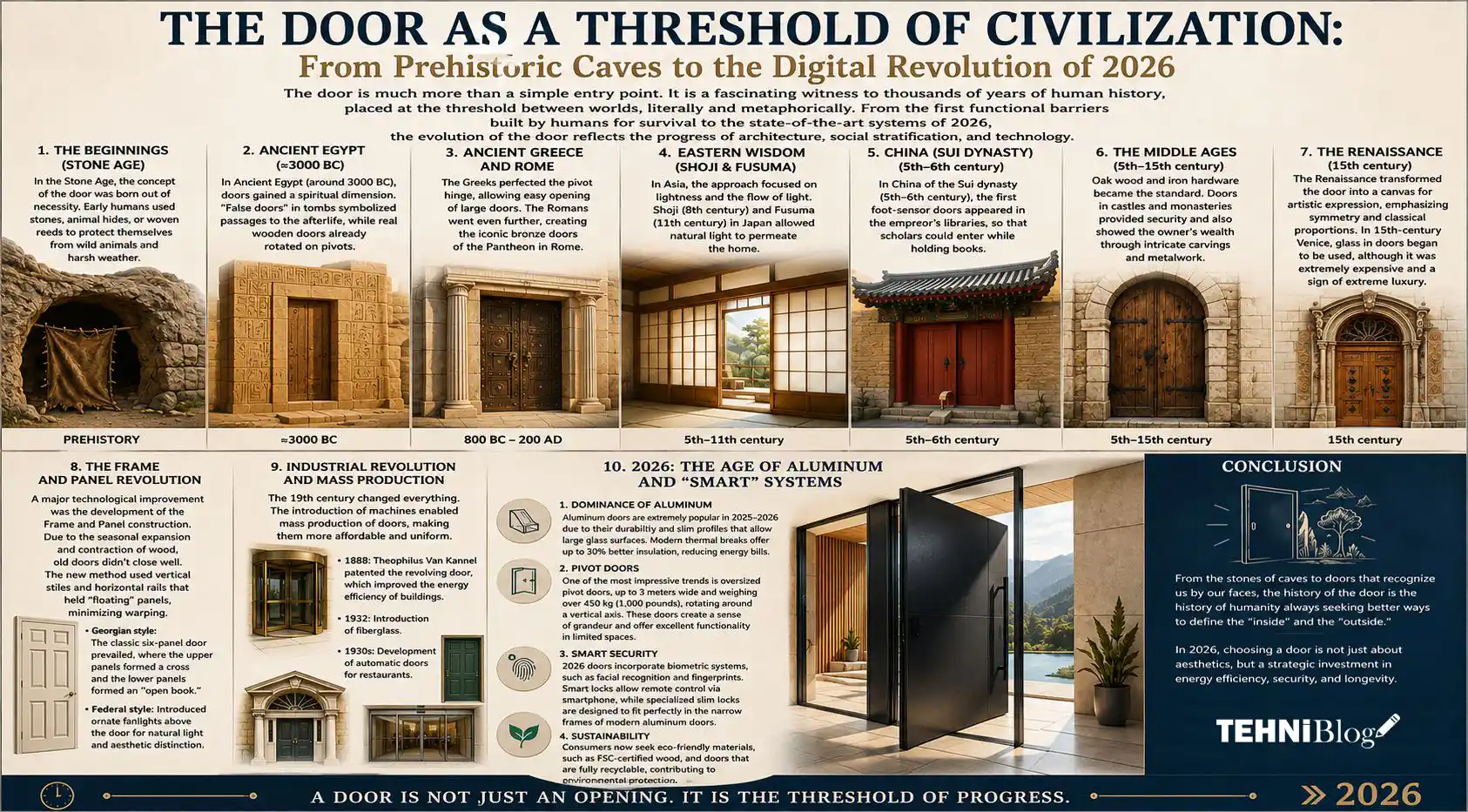
A door is far more than a simple point of entry. It is a fascinating witness to thousands of years of human history, positioned at the boundary between worlds, both literally and metaphorically. From the first functional barriers created by humans for survival to the ultra-modern systems of 2026, the evolution of the door reflects the progress of architecture, social hierarchy, and technology.
The Origins: The Need for Protection and Symbolism
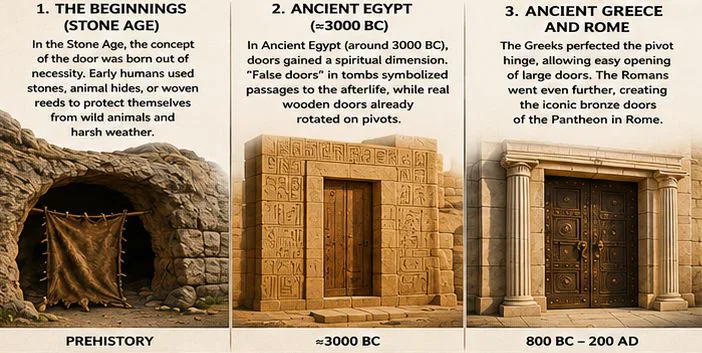
During the Stone Age, the concept of the door was born out of necessity. Early humans used stones, animal skins, or woven reeds to protect themselves from wild beasts and harsh weather conditions.
In Ancient Egypt (around 3000 BC), doors acquired a spiritual dimension. “False doors” in tombs symbolized passages to the afterlife, while real wooden doors already rotated on pivot pins.
In Ancient Greece and Rome, doors became symbols of prestige and permanence. The Greeks perfected the pivot hinge, allowing large doors to open with ease. The Romans advanced even further by creating the iconic bronze doors of the Pantheon in Rome. These monumental doors, over 7.5 meters high, remain functional to this day, although researchers debate whether they are the originals or medieval reconstructions. In addition, the Romans were the first to implement sliding and folding door systems.
Eastern Wisdom: Shoji and Fusuma
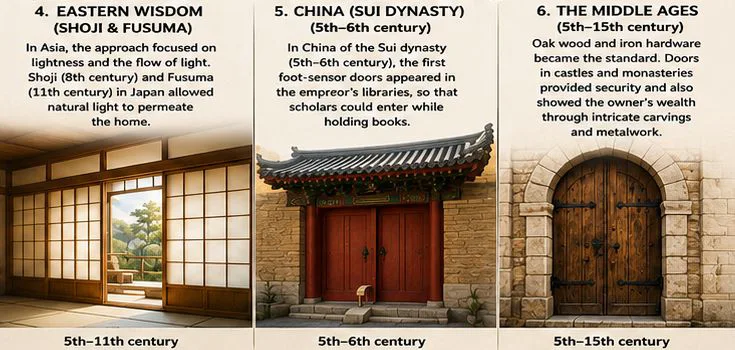
In Asia, the approach was different, focusing on lightness and the flow of natural light.
Shoji (around the 8th century) and Fusuma (11th century) in Japan, made of rice paper and wooden frames, functioned as flexible space dividers that allowed natural light to penetrate the home.
Remarkably, in China during the Sui Dynasty (5th–6th century), the first foot-sensor doors appeared in the emperor’s libraries, allowing scholars carrying books to enter more easily.
Middle Ages and Renaissance: The Art of Craftsmanship
During the Middle Ages, oak wood and iron fittings became the standard. Doors in castles and monasteries not only provided security but also demonstrated the owner’s wealth through elaborate carvings and metalwork. Construction relied on plank-style boards held together with horizontal battens and large nails.
The Renaissance transformed the door into a canvas of artistic expression, emphasizing symmetry and classical proportions. In 15th-century Venice, glass began to be used in doors, although it was extremely expensive and considered a sign of extraordinary luxury.
The “Frame and Panel” Revolution
An important technological advancement was the development of frame-and-panel construction. Due to the seasonal expansion and contraction of wood, older doors often failed to close properly. The new method used vertical stiles and horizontal rails to hold “floating” panels, minimizing warping.
Georgian Style
The classic six-panel door became dominant, where the upper panels formed a cross and the lower panels symbolized the “open Bible.”
Federal Style
Introduced ornate fanlights above the door for natural lighting and aesthetic distinction.
Industrial Revolution and Mass Production
The 19th century changed everything. The introduction of machinery enabled the mass production of doors, making them more affordable and consistent in quality.
In 1888, Theophilus Van Kannel patented the revolving door, which improved the energy efficiency of buildings.
In the early 20th century, the use of new materials such as fiberglass in 1932 and the development of automatic restaurant doors during the 1930s laid the foundations for the modern era.
2026: The Era of Aluminum and “Smart” Systems
Today, as we move toward 2026, trends focus on sustainability, security, and the aesthetics of the “inside-outside” connection.
1. Dominance of Aluminum
Aluminum doors are extremely popular in 2025–2026 due to their durability and slim profiles, which allow for large glass surfaces. Modern thermal breaks provide up to 30% better insulation, reducing energy bills.
2. Pivot Doors
One of the most impressive trends is oversized pivot doors, which can reach widths of up to 3 meters and weigh over 450 kg (1,000 pounds), rotating around a vertical axis. These doors create a sense of grandeur while offering exceptional functionality in limited spaces.
3. Smart Security
Doors in 2026 integrate biometric systems such as facial recognition and fingerprint scanning. Smart locks allow remote control through smartphones, while specially designed slim locks fit perfectly within the narrow frames of modern aluminum doors.
4. Sustainability
Consumers increasingly seek eco-friendly materials, such as FSC-certified timber, and fully recyclable doors that contribute to environmental protection.
Conclusion
From the stones of prehistoric caves to doors that recognize us by our faces, the history of the door is the history of humanity searching for ever better ways to define the “inside” and the “outside.”
In 2026, choosing a door is not only about aesthetics, but also a strategic investment in energy efficiency, security, and longevity.
SOURCE: TEHNi Technical Department
Engineers of various specialties (Production, Mechanical, Electrical and Chemical) make up the TEHNi Technical Department with over 30 years of experience.