Discover what the CE marking on TEHNi aluminium doors means, the requirements, standards, and certification steps necessary for legal distribution within the European Union.
Introduction
CE Marking for aluminium doors is a fundamental and mandatory requirement for the legal distribution of aluminium frames and entrance systems within the European Union market. Although it is often perceived as a simple label, it is actually a comprehensive compliance process involving European regulations, technical standards, and quality control procedures.
In this complete guide, we explain in a clear and understandable way what CE marking means, who needs it, which standards apply to aluminium doors and windows, and how it can be obtained correctly and without risk.
What is CE Marking and Why is it Mandatory
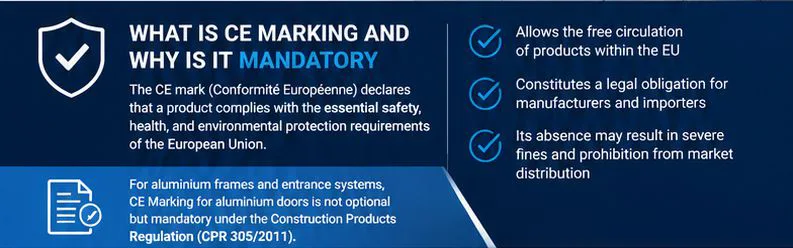
The CE mark (Conformité Européenne) declares that a product complies with the essential safety, health, and environmental protection requirements of the European Union.
Legal Significance
- Allows the free circulation of products within the EU
- Constitutes a legal obligation for manufacturers and importers
- Its absence may result in severe fines and prohibition from market distribution
For aluminium frames and entrance systems, CE Marking for aluminium doors is not optional but mandatory under the Construction Products Regulation (CPR 305/2011).
Which Aluminium Products Require CE Marking
Not all aluminium products require CE certification. The requirement applies when the product:
- Is used in structural or construction applications
- Affects the energy performance or safety of the building
Indicative Products
- Aluminium windows
- Balcony doors
- External entrance doors
- Sliding systems
- Fire-rated doors (with additional requirements)
European Standards for Aluminium Doors
The main harmonized standard is EN 14351-1.
It applies to:
- Windows
- External doors
- Balcony doors
Main Performance Characteristics Evaluated
- Resistance to wind load
- Watertightness
- Air permeability
- Thermal insulation (Uw)
- Acoustic insulation
- Mechanical resistance and operational safety
Step-by-Step CE Certification Process
The CE Marking process for aluminium doors includes specific stages:
1. Product Identification
Definition of the frame or door type and its intended application.
2. Initial Type Testing (ITT)
Testing in an accredited laboratory for the required performance characteristics.
3. Factory Production Control (FPC)
Implementation of an internal quality control system within the manufacturing facility.
4. Technical Documentation File
Includes:
- Test reports
- Drawings and specifications
- Inspection and quality control procedures
5. Declaration of Performance (DoP)
A legal document declaring the product’s performance characteristics.
6. CE Mark Placement
Application of the CE mark on the product or accompanying documentation.
Frequently Asked Questions (FAQs)
1. Is CE marking mandatory for all frames and doors?
Yes, for all frames and doors permanently installed in buildings within the EU.
2. What is the difference between CE and ISO?
CE relates to the product itself. ISO relates to the company’s quality management system.
3. Does CE marking require renewal?
No, unless the product or its performance characteristics change.
4. What happens if I do not have CE marking?
Market prohibition, fines, and legal penalties may apply.
Conclusion
CE Marking for aluminium doors is a cornerstone requirement for every professional in the aluminium industry who wishes to operate legally, safely, and competitively within the European market. With proper preparation, technical expertise, and compliance, CE certification becomes not just an obligation but a strategic advantage.
For homeowners, it serves as a guarantee of high quality and assurance that the product complies with European Union standards and specifications.
All TEHNi doors carry CE marking, are manufactured under an FPC system, and are accompanied by a Declaration of Performance, with a unique production number that enables product support even many years after installation.
SOURCE: TEHNi Technical Department
Engineers of various specialties (Production, Mechanical, Electrical and Chemical) make up the TEHNi Technical Department with over 30 years of experience.