Understand how thermal transmittance (U-value) is calculated in TEHNi aluminium entrance doors and how it contributes to energy efficiency.
Why the Thermal Transmittance of Aluminium Doors According to EN ISO 10077 Matters
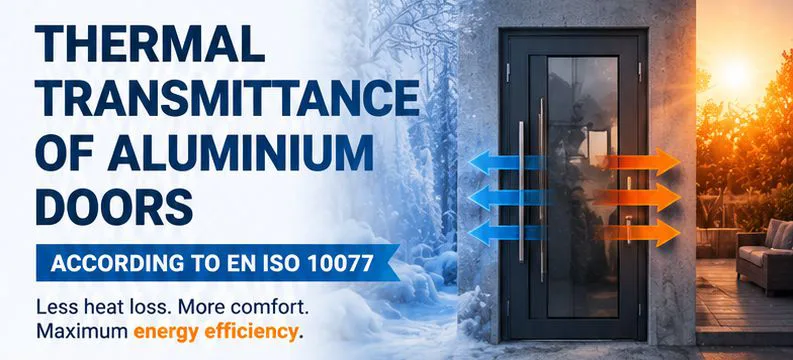
The thermal transmittance of entrance doors — especially aluminium doors — is one of the most critical factors for thermal comfort, reduction of energy losses, and compliance with modern energy regulations. The EN ISO 10077 standard provides the methodology to objectively calculate and compare the performance of different entrance doors and frame systems.
What is “Thermal Transmittance” (U-value / U-factor)
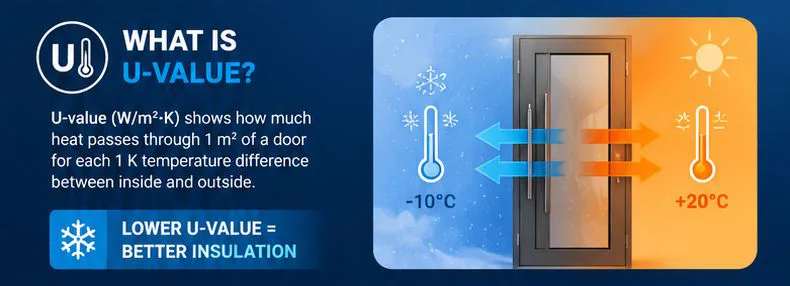
Thermal transmittance is expressed by the U-value, measured in W/(m²·K).
Essentially, it indicates how much heat passes through 1 m² of the door when there is a temperature difference of 1 K between the interior and exterior. The lower the U-value, the better the thermal insulation — meaning lower heat loss (or cooling loss) to and from the environment.
The EN ISO 10077 Standard — What It Defines
Purpose & Scope of Application
- EN ISO 10077 defines methods for calculating the thermal transmittance of windows, entrance doors, shutters with glazing, and opaque panels.
- It applies to constructions with different frame materials — wood, PVC, metal — and allows performance assessment even when complex profiles, thermal breaks, or composite structures are involved.
- It does not apply to industrial or garage doors, nor to curtain wall constructions.
How the U-value of a Door / Frame System is Calculated
Main Components
- Ug: U-value of the glazing or transparent element (insulating glass unit), calculated according to glazing standards such as EN 673.
- Uf: U-value of the frame/profile. For aluminium frames, this is typically determined through numerical simulation according to Part 2 of the standard.
- Ψ (Psi) — Linear thermal transmittance: Represents the additional heat loss occurring at the junctions between the frame and glazing or panel, spacer bars, etc.
Especially for Aluminium Entrance Doors
Why Aluminium Requires Attention
- Aluminium, as a metal, has high thermal conductivity, which means that without thermal break technology, significant heat losses occur.
- For this reason, modern aluminium doors use thermal-break structures: polyamide or other insulating materials combined with gaskets and insulation components to reduce conductivity.
- Without thermal break technology and careful design, an aluminium door may have poor thermal insulation and a high U-value, making it unsuitable for energy-efficient buildings.
Advantages When the Standard is Properly Applied
- With proper design and compliance with EN ISO 10077, aluminium doors can achieve excellent thermal insulation, reducing heat losses and energy consumption.
- The standard provides an objective way to compare different doors based on measurable and standardized values (Uf, Ug, Ψ).
- Compliance with the standard can support inclusion in energy certification schemes and building energy performance regulations, which is particularly important for residential and commercial buildings.
Practical Tips for Aluminium Entrance Doors with Good Thermal Insulation
1. Prefer Systems with Thermal Break Technology
Choose aluminium profiles containing intermediate materials with low thermal conductivity.
2. Verify Certified U-values
Ensure that the U-values (Uf, Ug, Ψ) have been calculated or certified according to EN ISO 10077. Request technical datasheets or certifications.
3. Use High-Performance Glazing
Prefer double or triple glazing with appropriate thickness and proper airtightness, especially if the door includes glass or transparent elements.
4. Check Seals and Gaskets Carefully
Actual performance also depends on manufacturing quality and proper installation.
Frequently Asked Questions (FAQs)
1. What is U-value and why is it measured for doors and windows?
U-value is the rate of heat transfer per square meter and per degree of temperature difference (W/(m²·K)). It is measured to evaluate how effectively a door or window insulates — meaning how much heat is lost or enters the building. A low U-value indicates good thermal insulation and lower energy loss.
2. What is the EN ISO 10077 standard?
It is an international standard defining methods for calculating the thermal transmittance (U-value) of openings such as windows and doors. It consists of two parts: Part 1 (general/simplified method) and Part 2 (numerical method for frames).
3. Can EN ISO 10077 be applied to aluminium doors?
Yes — especially for aluminium doors and frames with complex profiles, it is essential for accurately calculating the thermal transmittance of the frame.
4. What does the standard not take into account?
It does not take into account air leakage, solar radiation, condensation, or actual installation and usage conditions. Therefore, it does not cover all real environmental factors.
5. What does “linear thermal transmittance” (Ψ / Psi) mean?
This term refers to the additional heat loss occurring at frame-to-glass junctions, perimeters, spacer bars, etc. It is important because these areas often become thermal bridges in doors with metal frames and glazing.
6. What should someone look for when selecting an aluminium door with good thermal performance?
Choose a door with thermal break technology, certified Ud / Ug / Ψ values according to EN ISO 10077, high-quality gaskets and seals, and professional installation. Double or triple glazing is also recommended if the door contains glass panels.
7. Do TEHNi Aluminium Doors Have Thermal Transmittance Certification?
TEHNi doors are manufactured according to the EN ISO 10077 standard and achieve Ud values as low as 0.76 W/(m²·K), making them suitable even for Passive House constructions. Furthermore, the exclusive ISO Max system — including polyurethane foam-filled chambers combined with energy-efficient triple glazing — provides the ultimate combination of thermal insulation performance.
SOURCE: TEHNi Technical Department
Engineers of various specialties (Production, Mechanical, Electrical and Chemical) make up the TEHNi Technical Department with over 30 years of experience.