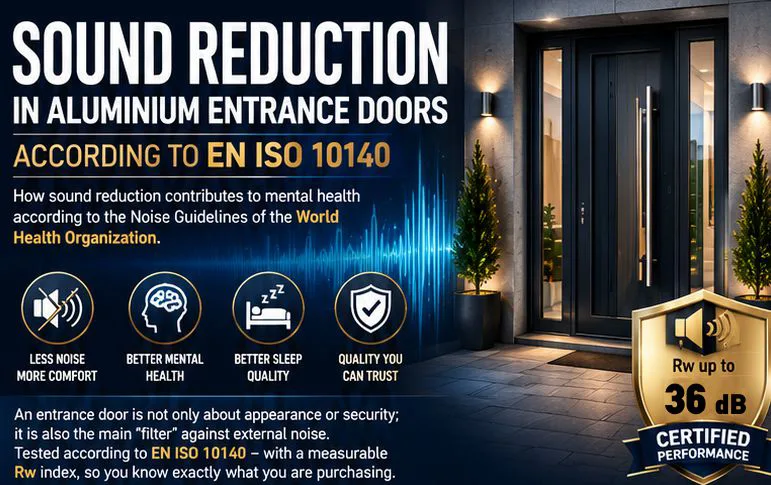
How sound reduction contributes to mental health according to the Noise Guidelines of the World Health Organization.
The importance of certified TEHNi doors in reducing external noise.
Sound reduction in aluminium entrance doors is a critical element of quality, safety, and comfort. An entrance door is not only about appearance or security; it is also the main “filter” against external noise.
The phrase “sound reduction in aluminium entrance doors according to the EN ISO 10140 standard” describes exactly this: a door that has been tested using laboratory methods according to an internationally recognized standard and is accompanied by a measurable sound reduction index (Rw), so you know exactly what you are purchasing.
The Concept of Sound Reduction and Why It Is Critical for Entrance Doors
Sound reduction (or sound insulation) is the ability of a building element to limit the transmission of airborne sound from one space to another. In entrance doors, this means how much less you hear cars, neighbors, traffic, construction works, machinery, or voices.
The higher the measured value in dB (e.g., Rw = 40 dB), the less noise passes through the door. In practice, every additional 10 dB of noise reduction corresponds approximately to the perception that the noise is “cut in half.”
Regulatory Framework: Greek Building Regulation & Category B
According to the Greek Building Regulation (Article 22), all new buildings in Greece must meet at least the requirements of Category B – “normal acoustic comfort.”
This means that the building envelope design (walls, frames, entrance doors) must ensure protection against:
- Airborne noise (traffic, people, music)
- Impact noise (footsteps, impacts)
- Noise from installations and external sources (fans, machinery, urban networks)
An aluminium entrance door with good sound reduction contributes significantly to achieving these goals.
Noise Targets According to WHO and the EU
Indicative maximum acceptable indoor noise levels according to the World Health Organization and European guidelines:
- Homes (daytime): 30–35 dB
- Homes (night): 20–25 dB
- Bedrooms (sleep): 30 dB maximum
In densely populated urban environments, where external noise levels can easily exceed 60–70 dB, sound reduction in aluminium entrance doors becomes an essential tool for achieving these values.
The EN ISO 10140 Standard – What It Defines
EN ISO 10140 is the international/European umbrella standard for laboratory measurements of sound insulation in building elements.
ISO 10140-2
Describes the laboratory method for measuring airborne sound insulation of building elements (such as doors) in two acoustic rooms: a source room and a receiving room.
ISO 10140-1
Defines the application rules for various elements. For doors, the test opening usually has a surface area of less than 10 m², and the specimen is installed close to the floor. The door is opened and closed at least five times before measurement to simulate realistic operating conditions.
The results of these tests are used to determine the Rw index.
Key Factors Affecting Sound Reduction in Aluminium Doors
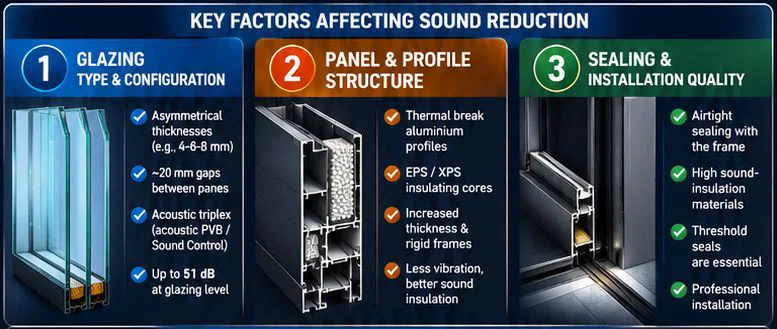
There are three main categories of factors influencing the result:
- The type and configuration of glazing
- The structure of the panel and profile (door leaf & frame)
- Sealing and installation quality
Role of Glazing – Asymmetrical Thicknesses, Gaps & Acoustic Triplex
- Glazing is the most critical factor in sound insulation performance.
- Asymmetrical thicknesses (e.g., 4–6–8 mm instead of 4–4–4) prevent simultaneous resonance of the glass panes and improve sound reduction.
- Larger gaps between double/triple glazing increase sound insulation, with ideal gaps reaching approximately 20 mm.
- Laminated glazing with acoustic interlayers (acoustic PVB / Sound Control) offers even better performance. The use of 2–4 acoustic interlayers can achieve noise reduction of up to approximately 51 dB at glazing level.
Panel and Profile Structure – Thermal Break & EPS Cores
Thermally broken aluminium profiles improve not only thermal insulation but also sound reduction, as they interrupt the transmission bridge.
The use of insulating cores inside the profile chambers (e.g., expanded polystyrene – EPS or mineral wool) significantly enhances sound absorption.
Aluminium panels for entrance doors usually feature internal cores made of such materials to combine thermal and acoustic insulation.
Increased door thickness and rigid frames reduce vibrations and help block sound.
Sealing, Airtightness & Installation Quality
Even the most technologically advanced door leaf will fail if the door does not seal properly.
- The door must create airtight joints with the frame.
- Joints between frame and wall must be filled with high sound-insulation materials.
- Threshold seals are essential because sound often passes underneath the door.
- Minor frame distortions can dramatically reduce gasket performance.
Practical Tips for Choosing an Aluminium Entrance Door with High Sound Reduction
1. Request ISO 10140 Certificates
Request ISO 10140 certificates with declared Rw values.
2. Prefer Laminated Acoustic Glazing
Prefer laminated acoustic glazing with asymmetrical thicknesses and ~20 mm gaps.
3. Choose Thermally Broken Aluminium Profiles
Choose thermally broken aluminium profiles with integrated insulating materials.
4. Ensure the Panel Has an EPS or XPS Core
Ensure the panel has an EPS or XPS core.
5. Pay Attention to Sealing
Pay attention to perimeter sealing and threshold seals.
6. Use Specialized Installation Teams
Use specialized installation teams.
FAQ – Frequently Asked Questions
1. What exactly is sound reduction according to EN ISO 10140?
It is the sound insulation performance of an aluminium entrance door measured according to EN ISO 10140.
2. What is considered a good Rw value?
Well-insulated aluminium doors usually achieve 25–40 dB, while some certified series reach up to 47 dB.
3. Which factor affects sound reduction the most?
Glazing plays the dominant role, especially in doors with large glass surfaces.
4. Why is proper installation important?
Because sound finds the easiest path through gaps, poor sealing, or distortions.
5. Do TEHNi aluminium doors have sound reduction certification?
TEHNi doors are certified to provide sound insulation of up to 36 dB. They feature panels with an XPS core, profile chambers filled with expanded polyurethane, and special glass units with sound-insulating membranes.
Conclusion
Sound reduction in aluminium entrance doors according to EN ISO 10140 is a measurable property that directly affects everyday comfort and quality of life.
By choosing certified products, reviewing technical specifications carefully, and working with experienced installers, an aluminium entrance door can transform your space into a quiet, protected, and high-quality environment.
SOURCE: TEHNi Technical Department
Engineers of various specialties (Production, Mechanical, Electrical and Chemical) make up the TEHNi Technical Department with over 30 years of experience.